 Paljet
forging Wind Turbine Gearbox Components
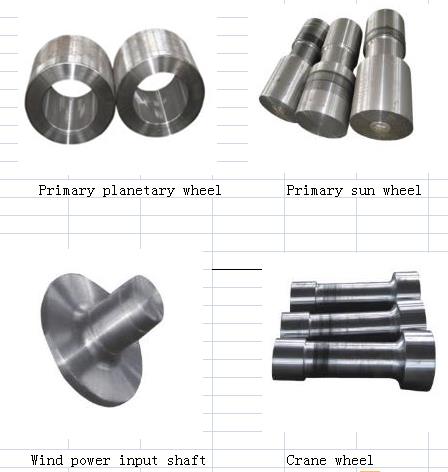
forging Wind Turbine Gearbox Components
1. Product Positioning & Application Fields
1st Stage Planet Gear (18CrNiMo7): The primary load-bearing part for the first-stage planetary transmission. It endures alternating impact loads, high tooth contact stress and tooth root bending fatigue, distributing power at the gearbox input end.
Wind Turbine Input Shaft (34CrNiMo6): Power input spindle connecting wind rotor and gearbox. It transmits large torque under combined torsion and bending loads, requiring high hardenability, good toughness and fatigue resistance.
2nd Stage Sun Gear (18CrNiMo7): Central driving gear for secondary planetary transmission. It bears heavy meshing load and is critical for secondary power transfer, with strict requirements on tooth surface wear resistance, tooth root anti-fatigue performance and heat-treatment deformation control.
All components are engineered for 20-year design life of wind turbines. With carburizing quenching or quenching & tempering plus precision gear machining, they feature excellent fatigue strength, low-temperature impact toughness, and strong resistance to pitting and tooth breakage.
Application fields: Speed-up gearboxes for onshore and offshore wind turbines, compatible with mainstream models of 1.5MW, 2MW, 3MW and 5MW. They can also be used in heavy-duty industrial planetary reducers and large mining transmission equipment under severe heavy-load conditions. We support OEM supply for domestic wind turbine manufacturers and export for overseas wind power projects.
2. Process Capability Overview
A complete manufacturing workflow covers forging blank production, heat treatment, precision machining and tooth surface strengthening for all three parts.
Process flow: Raw material incoming inspection → Cutting → Open-die forging / ring rolling for blanks → Preliminary heat treatment (normalizing + tempering) to relieve forging stress, homogenize microstructure and refine grains → Rough machining.
Different heat treatment schemes are adopted according to material grades:
18CrNiMo7 (1st stage planet gear & 2nd stage sun gear): Controlled atmosphere carburizing & quenching + low-temperature tempering to achieve gradient performance with hard surface and tough core. Shot blasting removes oxide scale, followed by semi-finishing, CNC precision gear grinding (tooth profile & lead modification), tooth root shot peening strengthening and dimensional finishing. Gear precision reaches ISO Class 4~6.
34CrNiMo6 wind turbine input shaft: Quenching and high-temperature tempering to obtain uniform comprehensive mechanical properties. Subsequent finish machining, cylindrical grinding and keyway processing, final inspection to control shaft bending deformation.
The factory is equipped with heavy forging equipment, computer-controlled heat treatment production lines, high-precision CNC gear grinders, cylindrical grinders and gear measuring centers. We accurately control effective hardened layer and heat treatment deformation to reduce meshing noise, restrain pitting, tooth fracture and shaft cracking, ensuring stable long-term operation under alternating loads.
3. Quality Control & Inspection
Closed-loop full-process quality control with multi-stage inspection from raw materials to finished goods.
Raw material inspection: Spectral composition test for 18CrNiMo7 and 34CrNiMo6 steel billets. UT ultrasonic inspection detects internal shrinkage and inclusion defects; original material certificates are verified.
In-process inspection: UT inspection after forging; metallography and grain size sampling after preliminary heat treatment. Furnace temperature and carbon potential are monitored in real time during heat treatment, with sampling tests for hardened layer or tempered hardness.
Finished product inspection
Gear parts (planet gear, sun gear): Gear measuring center tests tooth profile, tooth lead, pitch and runout; hardness test (surface HRC, core hardness, carburized layer depth); evaluation of metallographic structure, grain size and inclusions; UT internal inspection and MT magnetic particle inspection for surface cracks; low-temperature impact test.
Input shaft: Tempered hardness test, tensile & impact mechanical test; measurement of outer diameter, circular runout and keyway dimension; UT + MT inspection to detect internal and surface cracks.
Complete material reports and inspection certificates can be issued. Products comply with GB, ISO, AGMA and other international standards to meet acceptance specifications of wind power OEMs.
4. Customization Process
Requirement communication: Customers provide component drawings, unit power parameters, module / shaft diameter, precision grade, heat treatment indicators, applicable standards, order quantity and operating conditions (onshore / offshore, low-temperature environment).
Technical review: Our engineering team carries out strength calculation for gears and shafts, assesses manufacturability of forging and heat treatment processes, confirms technical solution and provides quotation and lead time.
Sign contract and technical agreement to lock dimensions, material grades, heat treatment parameters, NDT level and acceptance terms.
Manufacturing: Forging blank → Preliminary heat treatment → Rough machining → Targeted heat treatment (carburizing quenching / quenching & tempering) → Finish machining, gear grinding / cylindrical grinding, shot peening strengthening.
Finished product inspection: Complete physical & chemical test, non-destructive test and geometric accuracy inspection; compile full quality documents.
Acceptance, anti-rust protection, packaging and shipment. Full technical documents delivered with after-sales technical support.
Note: The above information is reviewed by Engineer Song Enyu from PALJET.
Next product: Crane Wheels, Sun Gears, Sprockets, Reducer Gears & ImpellersPrevious product:forging Alloy Steel Ingot