 Paljet
Extra-Large Flat-Oval Eccentric Slag Pot for Japan Project |Heavy Machinery OEM
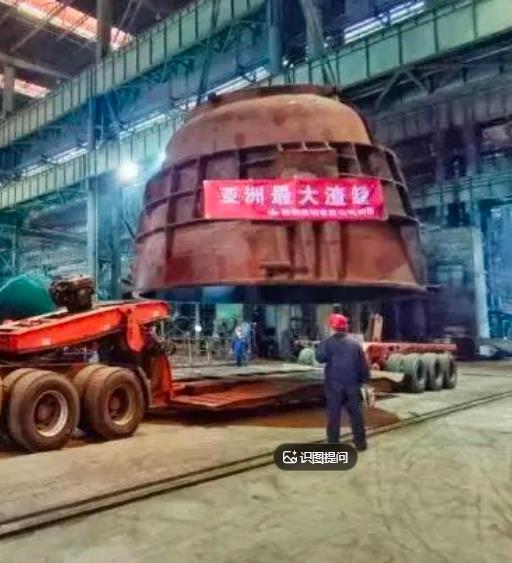
Extra-large flat-oval eccentric slag pot, cast steel slag ladle
for Japanese steel plant, Heavy Machinery OEM
1. Product Positioning & Application Fields
This extra-large flat-oval eccentric slag pot, manufactured by Ansteel Heavy Machinery for Japanese customers, is one of the world’s largest slag pots of this type. It is a high-end OEM heavy cast steel component for metallurgical industry.
The slag pot is the critical safety vessel for receiving, transporting and tilting high-temperature molten steel slag. Adopting eccentric trunnion design, it realizes automatic slag dumping during tipping. The flat-oval profile reduces overall height under the same volume to fit the overhead crane and site layout constraints of steel mills. It is manufactured in accordance with JIS Japanese cast steel standards plus supplementary customer technical specification, dedicated for overseas metallurgical OEM export projects.
Application Fields
Steelmaking workshops in Japan, used to hold, transport and discharge molten slag from converters and electric furnaces
New steel plant construction, spare part replacement and EPC metallurgical projects
Working under severe cyclic thermal shock, repeated rapid heating & cooling and mechanical impact. Strict requirements on steel purity, internal soundness and crack resistance at trunnion roots are mandatory for safety.
2. Process Capability Overview
Casting simulation & customized process design
MAGMA casting simulation software is applied to simulate molten steel filling, solidification, temperature field and shrinkage stress. For the complex flat-oval eccentric shape and heavy hot spots at trunnion bosses, gating & riser system and chills are optimized to predict hot tearing, shrinkage cavity and porosity. Special mould box and sand core are developed to control contour and eccentricity tolerance.
Steel smelting and multi-ladle pouring
Molten steel is refined in large ladles to strictly limit S and P content to meet JIS purity requirements. Multi-ladle synchronous pouring is adopted to fill the cavity in one run, controlling pouring temperature and flow rate to avoid cold shut, slag inclusion and blowholes. Special protection is implemented for trunnion roots to prevent hot cracks at thickness transition zones.
Shakeout, riser cutting & primary stress-relief heat treatment
After shakeout, gates and risers are cut and surface fins are ground. High-temperature stress-relief annealing is performed to eliminate casting residual stress and reduce cracking risk during machining and service. Preliminary visual inspection and UT screening are carried out.
Heavy-duty CNC machining (trunnion as key part)
Large horizontal boring & lathe machines finish trunnion OD, end faces and lifting reference surfaces. Tight control of coaxiality, center distance and eccentricity of dual trunnions ensures smooth tipping movement complying with drawing geometric tolerances.
Secondary heat treatment
Secondary heat treatment is implemented after semi-finishing to optimize metallographic structure and improve thermal fatigue resistance, removing machining stress and securing dimensional stability under repeated high-temperature cycles.
Surface treatment, permanent marking and coating
Blasting cleaning is performed. Permanent casting marks including heat number and part ID are made for full traceability as required by Japanese standards. High-temperature resistant heavy-duty anti-corrosion coating is applied for ocean shipment protection and mill service environment.
3. Quality Control & Inspection (Compliant with JIS G0307)
Full lifecycle traceability is maintained for every heat, heat treatment, NDT and dimensional record. Third-party witnessing inspection is available upon Japanese customer’s request.
Raw material & metallurgical test
Spectroscopic analysis on every heat. Cast-on test coupons are poured together with the casting for chemical composition, tensile, impact and hardness tests to satisfy JIS G0307 and contract specification.
Non-Destructive Testing (NDT) on high-risk zones
UT: applied on tank wall, bottom, trunnion bosses and thickness transitions to detect internal shrinkage, porosity, inclusions and internal cracks.
MT: 100% coverage on trunnions, rim and all fillet transition areas to detect surface and near-surface cracks.
PT: performed on machined trunnion surfaces for open tiny discontinuities.
3D dimensional inspection
Laser tracker measures flat-oval contour, eccentricity, trunnion coaxiality, trunnion center distance and wall thickness at multiple points. Full dimensional report is generated to verify tipping geometry.
Weld repair control
Any weld repair must follow customer-approved WPS. Repaired zones shall be fully re-tested by NDT. All repair records are documented and submitted for customer review.
Final delivery document package
Material certificates, heat records, heat treatment curves, full NDT reports, 3D dimensional inspection reports, weld repair logs and coating inspection records, available in bilingual English/Japanese.
4. Customization Process
Requirement discussion & technical input
Customer provides engineering drawings, volume, eccentricity parameters, material grade, JIS standard, NDT acceptance level and operating conditions. Our engineering team reviews manufacturing feasibility and evaluates key risks including flat-oval eccentric structure, trunnion load and thermal fatigue.
Technical agreement negotiation & signing
Lock material grade, dimensional tolerance of eccentricity, NDT scope, acceptance criteria, WPS repair rules, witnessing milestones, document list, packaging and ocean freight protection requirements.
Casting process review
Internal review of casting simulation, pouring scheme, heat treatment curve, machining workflow and NDT plan. Critical process proposals are submitted for Japanese customer approval.
Manufacturing & in-process witnessing
Production flow: Smelting → multi-ladle pouring → shakeout → primary heat treatment → rough machining → secondary heat treatment → trunnion finishing. Customer or third-party inspectors may witness key stages: pouring, heat treatment, NDT and dimensional recheck.
Final factory inspection & document acceptance
Full NDT and 3D dimensional re-verification. All technical documents are audited before customer factory acceptance and release.
Heavy cargo protection, packaging & export sea freight
Special protection for machined trunnions. Heavy cargo securing and anti-rust packaging for ocean transport. Oversized land transport to port, export documentation and full origin & inspection reports delivered.
Note: The above information is reviewed by Engineer Song Enyu from PALJET.
Next product:Large rolling mill frameLarge rolling mill framePrevious product:Hydro Turbine Upper Crown
| Large Stainless Steel Casting for Francis Turbine Runner